Three Organisations, One Vision: What Sheffield Taught Us About Place-Based Partnership
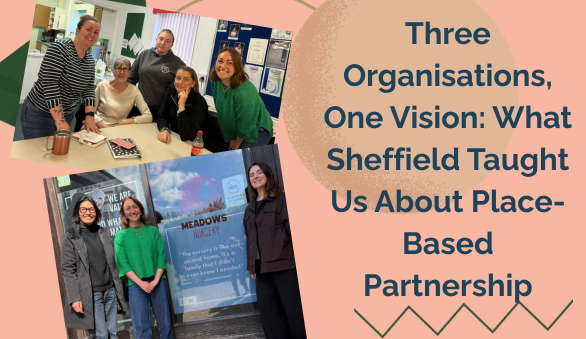
In early 2026, as part of our work to build a practice and evidence framework for place-based early years approaches, we visited Save the Children’s Early Learning Community in Shirecliffe, one of Sheffield’s most deprived neighbourhoods. What we found was one of the most innovative and instructive partnerships we’ve encountered in this work: three very different organisations, bringing very different assets, united by a shared vision of what a better early years system could look like.
A Partnership That Shouldn’t Exist (But Does)
Nothing about this model was designed from a blueprint. It evolved out of necessity, opportunity, and critically, a shared vision that kept everyone oriented when the path got difficult.
The Early Learning Community is based around a nursery that was closed during the first wave of austerity. Save the Children and Sheffield Hallam University were supporting the school to reopen the nursery when the pandemic hit. The school could no longer take this on so Hallam stepped in. The nursery did not open until April 2021, extending provision to two-year-olds, filling a gap that had existed since the free entitlement was introduced. Then the pandemic hit, and the choice became stark: let the project fold, or find a different way. Sheffield Hallam University stepped in, took on the nursery registration, employed all the nursery staff, and set up the Early Years Community Research Centre around it.
What emerged was a three-way partnership, each partner bringing what the others cannot.
Sheffield Hallam University brings the legal infrastructure to run a quality nursery outside the impossible economics of the PVI sector; research capacity that attracts external funding; student placements across architecture, psychology, occupational therapy, media and teacher training; and institutional credibility that gets research in front of decision-makers. Around 40% of the university’s students come from South Yorkshire, its civic mandate is principled, not accidental. The nursery is where that commitment becomes concrete.
Save the Children brings the community relationships and deep trust built over years; a national voice that can amplify local research directly to Westminster; innovation funding for everything beyond core provision: the family support work, co-design processes, the community group; and the independence from local authority funding that allows them to say things others won’t.
The community itself and here we mean parents, families, and the group they have built, You, Me, Us, brings lived knowledge; relationships with neighbours who trust no professional; the energy to fill the building five days a week; and an ambition to take this further than any of the professional partners originally imagined.
None of these three could do what they do together on their own. The university without Save the Children and the community would produce research for journals. Save the Children without the university and the community would be a time-limited project without enduring legacy. The community without Save the Children and the university would have no infrastructure, no funding routes, no way of making its voice heard beyond the neighbourhood. Together, they’ve influenced the Child Poverty Task Force and are now shaping a £20 million South Yorkshire investment in tackling child poverty.
Save the Children’s Role: Holding the Vision When Everyone Else Is Busy
One of the things we found hardest to pin down, but most important, was the role Save the Children plays that isn’t delivery and isn’t funding. It’s something closer to holding the vision on behalf of everyone when daily pressures push it out of reach.
Place-based work is particularly vulnerable to drift. Community workers are navigating crises. University academics have teaching commitments and REF pressures. Parents are managing five or six intersecting domains of insecurity, as the multiple insecurities research conducted here found. In that context, someone needs to keep asking: what are we actually trying to achieve? Are we still moving towards it?
That’s the coordinating, catalysing, joining-up function that Save the Children performs: making sure the nursery connects to the family support, which connects to the community group, which connects to the co-design process, which connects back to the research, which connects to policy. On the ground, this is almost invisible. Parents don’t know which organisation any particular staff member works for, and that seamlessness is intentional and hard-won.
From the Meadows to Westminster: Save the Children’s Three-Level Role
What makes the Sheffield model genuinely unusual is how Save the Children operates simultaneously at three levels that most organisations are forced to choose between.
At the hyper-local level, they are in the Meadows five days a week. They know the families, which parents are carrying the weight of housing insecurity, which children are on waiting lists, which neighbours have stopped leaving the house. There was a sense that Save the Children’s national strategy as a voice organisation only works if grounded in genuine relationships with children and families. The hyper-local work is what makes the national work credible and real, not the other way around.
At the regional level, Save the Children has been filling a gap that nobody else was filling. No organisation in South Yorkshire had a specific focus on child poverty. Save the Children stepped into that space, helping bring a shared vision to the region, drawing on international models including a UNESCO-inspired child lens investment framework, and convening a collective action plan across the South Yorkshire Combined Authority area. They are building towards a £20 million fund by the end of 2027 and have funded a coordination role that will eventually sit within the Combined Authority itself, deliberately building infrastructure that outlasts their involvement.
At the national level, the partnership with Sheffield Hallam closes a loop that most place-based projects leave open. The university produces research with rigorous ethical approval. Save the Children’s Westminster-facing colleagues take that research directly to policymakers. Work that might otherwise end up in a journal has been used by the Child Poverty Task Force, discussed in Cabinet Office visits, and fed into the Employment Rights Bill. A researcher working with the partnership said she was astonished: “I’m just not used to my research being used like this. I’m really used to conducting research and it being for the university.”
What connects all three levels is the voice of children, young people and families, placed at the centre. The vignettes developed through the multiple insecurities research, co-created with families to show the real texture of lives navigating multiple simultaneous challenges, are what make senior civil servants stop and listen. Lived experience, properly held and properly amplified, is the through-line.
You, Me, Us: When the Community Becomes the Partner
We also spent time with the group that, in many ways, best represents what this model is trying to achieve: You, Me, Us, a parent-led community group that grew out of the co-design work Save the Children and the nursery initiated in the Meadows.
Eighteen parents went through the first co-design process. What started as an attempt to understand what families needed became something much bigger. Parents began supporting each other, became trained researchers, started delivering training to other parents, and began going to events across the city, standing up in rooms full of people to talk about child poverty and why it matters, something several said would have been unimaginable a few years ago.
The group now effectively fills a void that statutory services have left. There are no other community organisations in this part of the Meadows, and the Family Hub operates just two days a week from an outreach building. Into that gap, You, Me, Us has stepped: running breakfast clubs, a food pantry, community events and peer support, and increasingly serving as a bridge to services that families wouldn’t otherwise reach or trust.
They want to become a CIC, take on more of the building, provide hot meals to nursery children, and run a youth organisation, moving from being the community this work is for into being co-creators and co-owners of it. That transition, from participant to partner to co-owner, is one of the deepest measures of whether a place-based model is working. The question of how You, Me, Us achieves financial sustainability without losing the spirit that makes it what it is remains genuinely open.
The Precariousness Beneath the Ambition
It would not be honest to write about Sheffield without sitting with its fragilities.
The nursery runs at a loss. Sheffield Hallam, like all other Higher Education institutions, is under increasing financial pressure, has to consider all areas of expenditure. You, Me, Us wants to become a CIC but doesn’t yet have clear routes to sustainable funding. The regional child poverty strategy is ambitious, but the £20 million fund is still being built. Child poverty itself is politically contested, and some in government are reluctant even to name it, meaning much of this work has to be threaded carefully through systems that don’t always make it easy.
And yet what we saw in Sheffield was not fragility dressed up as strength. It was people who understand the precariousness clearly, who keep going because the alternative, a neighbourhood with no nursery, no community group, no thread connecting local relationships to regional strategy to national policy, is worse. The question is not whether this model is perfect, but whether it points, with the right support, towards a better way.
We think it does.
What Sheffield Asks of Us
Across the different backbone organisations we’ve been learning from, Sheffield raises a set of questions we keep returning to.
What would it take for more universities to accept this kind of civic role, not as a PR exercise, but as a genuine, long-term commitment to a community? What would it take for national organisations like Save the Children to be explicitly resourced to hold the multi-level role they are playing in Sheffield, across hyper-local, regional and national levels, for the long term? What would it take for community groups like You, Me, Us to have genuine, reliable pathways to independence, without having to navigate grant processes designed for very different kinds of organisations?
And more fundamentally: what would it take for the family hub system being built nationally to look, even a little, like what already exists in the Meadows, present every day, the same people, no appointment needed, shaped by the families who use it?
Sheffield doesn’t answer those questions. But it makes them harder to ignore.
Place Matters is working with a community of practice of backbone organisations to develop a common practice and evidence framework for place-based approaches to early childhood.